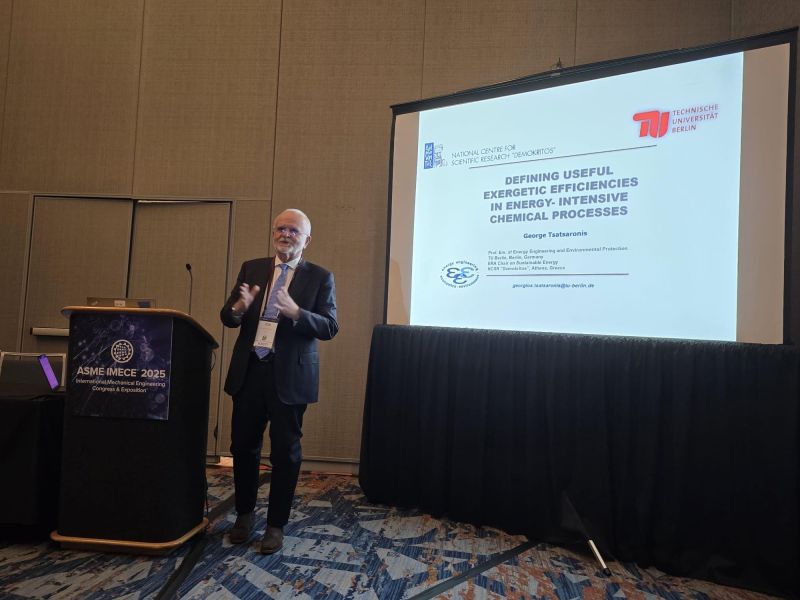
Prof. George Tsatsaronis, EXCELLEND’s ERA Chair Holder, participated in the ASME International Mechanical Engineering Congress & Exposition (IMECE) held in Memphis, USA, where he presented a research contribution on advanced methods for evaluating thermodynamic performance in complex energy systems.
His presentation, entitled “Defining Useful Exergetic Efficiencies in Energy-Intensive Chemical Processes”, addressed key challenges in the definition and interpretation of exergetic efficiencies, particularly in the context of complex chemical and energy-intensive systems.
The study highlights that while exergetic efficiency is widely recognized as a fundamental indicator for assessing the thermodynamic performance of energy conversion systems, its definition is not always consistently applied. In particular, energy-intensive chemical processes often involve multiple valid efficiency formulations, which can lead to ambiguity and inconsistent comparisons in the literature.
Prof. Tsatsaronis emphasized that traditional approaches based on total exergy may limit the meaningful comparison of different system components. To address this, the presentation proposed a more refined framework that relies on exergy differences rather than absolute values and incorporates a detailed representation of the function of each system component within the overall process.
The proposed approach further builds on advanced exergy analysis methods by distinguishing between endogenous and exogenous as well as avoidable and unavoidable exergy destruction. In addition, it considers the decomposition of exergy into thermal, mechanical, reactive, and non-reactive components, enabling a more detailed and physically meaningful assessment of system performance.
The methodology is particularly relevant for energy-intensive chemical processes such as ammonia synthesis, methanol production, and hydrogen generation, which were used as illustrative case studies in the presentation.
By improving the definition and interpretation of exergetic efficiencies, this work contributes to more robust performance assessment tools that can support both thermodynamic analysis and subsequent exergoeconomic and exergoenvironmental evaluations.
Through his participation in ASME IMECE 2025, Prof. Tsatsaronis represented both the EXCELLEND ERA Chair project and the Technische Universität Berlin, contributing to the international exchange of advanced methods in thermodynamics and energy systems analysis.